
Cat behaviour experts help you understand cat language
Most cat owners will be used to having conversations with their cat. We may respond to a meow with a ‘Yes, I know your breakfast is five minutes late, I’m ever so sorry’. Or deliver some loving words and a gentle chin scratch when prompted by a purr. But do cats talk to each other in the same way we communicate with them?
Clinical Animal Behaviourist Daniel Warren-Cummings decodes cat language to help us understand cat communication.
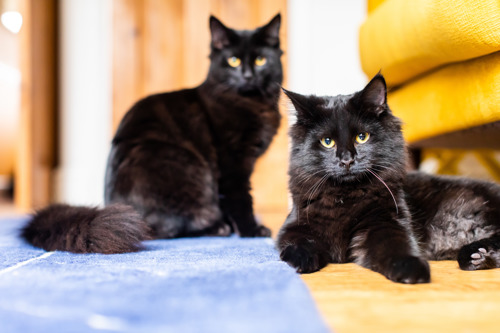
Do cats speak to each other?
It’s rare for cats to talk to each other using meows and other vocalisations. Our pet cats are descended from the solitary African wildcat. This means that they haven’t evolved the same social communication skills as dogs or humans.
Cats are more likely to use subtle body language and scent-based cues to communicate with each other. This special cat language allows them to communicate at a safe distance from each other. Scent marking can even help them communicate from miles away!
Pet cats usually only meow to communicate with humans. They’ve learnt that we respond to meows to give them what they want. Usually a tasty meal!
How cats communicate with each other
1. Body language
- Posture. Cats can say a lot with the shape and position of their body. Crouching down to look small shows they’re anxious. Arching their back and puffing up their fur signals that they feel threatened. Find out how to read your cat’s body language
- Ears, whiskers and eyes. Although cats don’t have the same facial expressions as we do to communicate how they’re feeling, their face can give some clues. The eyes, ears and whiskers can all signal their mood. Take a look at our body language guide above to find out more.
- Tail position. As well as being useful for balance, a cat’s tail can also show how they’re feeling. An upright tail means they’re happy and confident. Whereas a tucked or wagging tail could mean they’re scared or stressed. Find out more about cat tail meanings
2. Scent
Cats have an excellent sense of smell, much better than humans! They also have a special sensory organ, called the vomeronasal organ, located on the roof of their mouth. This helps them detect cat pheromones, which are chemical signals that only other cats can smell. If you’ve ever noticed your cat open their mouth and curl their lip slightly, this is the Flehmen response. It allows them to use the vomeronasal organ to analyse any pheromones nearby.
- Cheek rubbing. Cats have scent glands on their cheeks that produce pheromones. By rubbing their cheeks on objects, they spread these pheromones to mark their territory
- Scratching. Cats also have scent glands between their toes. By scratching objects, they leave behind pheromones that show this is a safe part of their territory. Find out more about scratching
- Spraying. Spraying pee has a few different uses. It helps cats mark their territory, signal for a mate, or it could be a sign that they’re stressed. Find out more about spraying
3. Touch and grooming
Cats will usually avoid any physical contact with each other, preferring to communicate from a distance. But if cats are socially bonded to each other, they may:
- rub against each other
- touch noses
- intertwine their tails
- groom each other
- sleep snuggled up together
These behaviours are a sign that your cats are ‘talking’ to each other. They allow cats to transfer pheromones onto each other to mark them as safe and trusted. If your cats show these behaviours, it’s a good sign that they’re friends.
4. Vocalisation
Although cats rarely communicate with other cats using vocalisations, there are some instances where they may ‘speak’ to each other. These include:
- kittens and their mother. Soft mews, chirrups and trills help kittens bond and communicate with their mum
- mating behaviour. Unneutered male and female cats may yowl to attract a mate
- conflict: Cats may hiss or growl when they feel threatened by another cat and cannot get away. This noises signal to the other cat to back off
How do mother cats communicate with their kittens?
 Mother cats and kittens communicate using two methods:
- vocalisation. Kittens mew to get the attention of their mum, and mother cats use chirrups and trills to speak to their litter. Once kittens grow up, it’s rare for them to be vocal with their mum, even if they continue living together
- scent. The mother cat and kittens release pheromones so they can identify each other and give signals about how they’re feeling. Kittens have even been known to prefer a particular teat when drinking their mother’s milk. They can identify their favourite teat through scent
Find out more about cat pregnancy and kitten care.
Do cats understand when other cats meow?
Cats may respond to specific sounds from other cats, for example:
- calling for a mate. If an unneutered cat hears another unneutered cat yowling, they may try to find them so they can mate. Find out more about cat reproduction
- hissing or growling. If a cat hisses or growls at another cat, this is them saying they want the other cat to back off. Some cats may respect their wishes and leave them alone. Other cats may stand their ground. If neither cat backs away, they may resort to fighting. Find out more about cats and fighting
- mother cats and kittens. Mum cats and their kittens will understand each other’s mews, chirrups and trills so they can stay together and look after each other
Other than these examples, cats don’t usually meow at each other.
Why is my cat meowing at my other cat?
If your cats are neutered and meowing at each other, this is likely a sign that they’re not getting along. Make sure your cats have space to get away from each other. If they can’t escape, they may resort to having a physical fight. Find out how to help cats get along.
If either or both of your cats aren’t neutered, they could be meowing at each other as a sign they want to mate. If you don’t want your cats to have kittens, keep them separated until you get them neutered. Remember that even cats who are related to each other can mate! Find out more about neutering.
Can cats communicate telepathically?
There’s no scientific evidence that any animal, including cats, can communicate telepathically. Instead, cats use body language and scent marking to ‘talk’ to each other without making a sound.


